Texas · Driver LicenseTexas Permit Practice Test
The Texas permit test is administered by Texas Department of Public Safety. This free practice test covers the 10 areas the Texas Driver Handbook teaches, from vehicle control and communication to insurance and collisions, with 100 questions written for Texas and every answer explained. Pick 25, 50, or 100 questions and start; there is no sign-up.
Free practice testTake the Texas permit practice test
The Texas bank holds 100 questions written for the Texas Driver Handbook (Revised January 2026), 7 of them illustrated with a sign, signal, marking, or road scene. Choose a Quick check of 25, a Practice run of 50, or the Full challenge of 100 on the next screen, then choose coaching mode, which explains every answer as you go, or exam mode, which holds the explanations until the end and still shows your running score. It is free, there is no sign-up, and a test in progress is saved on this device.
Start the Texas practice testSample questionsSix questions from the Texas bank, with the rule behind each answer
Sample 1 · Vehicle Control And CommunicationDuring an equipment check, from what minimum distance must a Texas passenger car's horn be audible?
- A200 feetCorrect
- B50 feet
- C100 feet
- D500 feet
Why: A passenger vehicle's horn must be audible from at least 200 feet away. Therefore, the supported response is "200 feet".
Sample 2 · ParkingWhich sequence best prepares a driver to leave a parked vehicle safely?
- ATurn off the engine, set the brake, remove the key, and check behind before openingCorrect
- BLeave the engine running and open the door immediately
- CRelease the parking brake and leave the key
- DOpen the traffic-side door before looking
Why: Before leaving a parked vehicle, the driver should shut off the engine, set the parking brake, remove the key, and check for traffic before opening the door. Therefore, the supported response is "Turn off the engine, set the brake, remove the key, and check behind before opening".
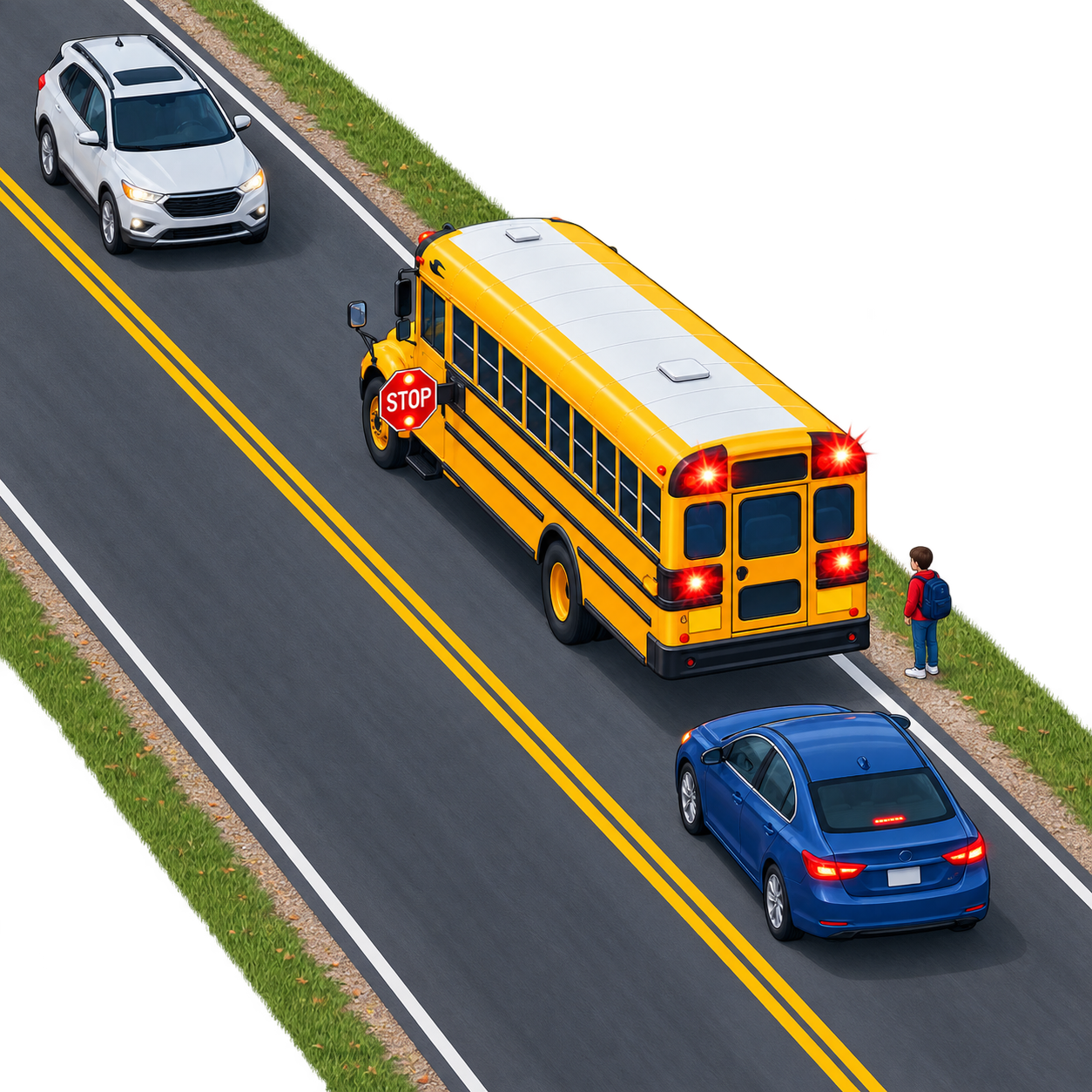
Sample 3 · Sharing The RoadOn an ordinary two-way road, a school bus ahead displays alternating red lights. What must traffic in both directions do?
- AStop and remain stopped until a release condition occursCorrect
- BSlow to 20 mph and pass
- COnly traffic behind the bus must stop
- DProceed if no child is visible
Why: Drivers approaching a school bus from either direction must stop while its alternating red lights are flashing, unless a stated roadway exception applies. Therefore, the supported response is "Stop and remain stopped until a release condition occurs".
Sample 4 · Speed And Road ConditionsOn a dry road at 25 mph, what is the minimum following interval described in the handbook?
- AFour seconds
- BTen seconds
- CTwo secondsCorrect
- DOne second
Why: In good road conditions at 30 mph or less, the handbook specifies a minimum two-second following interval. Therefore, the supported response is "Two seconds".
Sample 5 · Occupant SafetyWho must buckle up in a passenger vehicle when their seat has a safety belt?
- AOnly front-seat occupants
- BOnly passengers under age 18
- CThe driver and every passengerCorrect
- DOnly the driver
Why: The driver and every passenger, regardless of age, must use a safety belt when occupying a belt-equipped seat in a passenger vehicle. Therefore, the supported response is "The driver and every passenger".
Sample 6 · Insurance And CollisionsWhich set matches Texas's listed minimum liability amounts?
- A$50,000 / $50,000 / $50,000
- B$100,000 / $300,000 / $100,000
- C$30,000 / $60,000 / $25,000Correct
- D$10,000 / $20,000 / $5,000
Why: The minimum liability amounts listed are $30,000 for one person's injury or death, $60,000 for two or more people, and $25,000 for property damage. Therefore, the supported response is "$30,000 / $60,000 / $25,000".
What is on the testThe 10 topics the Texas permit practice test covers
These are Texas's own topic areas, from vehicle control and communication to insurance and collisions, each with 10 questions. Under each one are two questions from the bank, shown without their answers; the practice test explains every one of them.
Vehicle Control And Communication10 questions
- What rearward viewing distance must a passenger car's rearview mirror provide?
- Which item must work properly so a driver can maintain visibility during bad weather?
Lanes Turns And Passing10 questions
- A two-lane road reaches a railroad crossing in 80 feet. May you move left of center to pass?
- You are 60 feet from a bridge on a two-lane road. What is the correct passing decision?
Parking10 questions
- Is it legal to stop beside a car already parked at the curb, leaving your vehicle in the travel lane?
- Which location is prohibited even for a short parking stop?
Signals Signs And Right Of Way10 questions
- At the illustrated STOP sign, slowing to walking speed finds no visible traffic. What must the driver still do?
- What instruction is associated with the illustrated triangular road sign?
Sharing The Road10 questions
- Which situation is identified as an exception to stopping for a school bus's red lights?
- A person is already in an uncontrolled crosswalk when your vehicle approaches. What must you do?
Speed And Road Conditions10 questions
- Traffic is moving at 45 mph on a dry road. What following interval should you maintain?
- Heavy rain limits the clear view ahead. How should you choose your speed?
Emergencies And Distracted Driving10 questions
- A disabled car is stuck in a travel lane. What should its occupants do when they can exit safely?
- Your vehicle breaks down on the roadside after dark. Which lighting plan best matches the handbook?
Occupant Safety10 questions
- A seven-year-old passenger is 4 feet 4 inches tall. What restraint is required?
- Does riding in a pickup remove the requirement to use an available safety belt?
Alcohol And Drugs10 questions
- Before driving after taking a nonprescription cold medicine, what should you do?
- Why is combining alcohol with a sedating medication especially unsafe before driving?
Insurance And Collisions10 questions
- Who may require you to provide proof of financial responsibility after a crash?
- Can a driver use a phone image as proof of insurance?
How to prepareA study plan for the Texas permit test
1Find out where you stand
Take a Quick check of 25 in coaching mode. Read each explanation, including the ones you got right; it tells you the rule Texas tests, not just the answer.
2Study the topics you missed
Your account's Study tab ranks the 10 topics by your results. Read that chapter of the Texas Driver Handbook, then take another Quick check to confirm the gap has closed.
3Rehearse the real thing
Take the Full challenge of 100 in exam mode. Aim for 80 percent or better twice in a row; at that point you are answering from the rules, not from memory of the questions.
QuestionsTexas permit practice test questions
?Is this the official Texas permit test?
No. DMV Exam Pass is an independent study service and is not affiliated with Texas Department of Public Safety. The questions are written in the style of the exam to prepare you for it; the official test is taken with the agency.
?What does the Texas permit practice test cover?
The 100 questions are spread evenly across 10 topics: Vehicle Control And Communication, Lanes Turns And Passing, Parking, Signals Signs And Right Of Way, Sharing The Road, Speed And Road Conditions, Emergencies And Distracted Driving, Occupant Safety, Alcohol And Drugs, and Insurance And Collisions. Every test you take draws from all of them, so a weak area shows up quickly.
?How many questions are in the practice test, and how long does it take?
The Texas bank holds 100 questions. A Quick check of 25 takes about ten minutes, a Practice run of 50 about twenty, and the Full challenge of 100 about forty. You can pause any time.
?Are these the real questions from the Texas exam?
No. Nobody outside the agency has the real questions, and we do not use, claim, or advertise leaked or exact exam questions. These are independently written questions that test the same rules, so what you learn transfers to whatever the real test asks.
?Which handbook should I study for the Texas permit test?
The Texas Driver Handbook (Revised January 2026), published by Texas Department of Public Safety. Every question here is written for it, and each explanation names the rule, so when you miss a question you know which chapter to read.
?What is the difference between coaching mode and exam mode?
Coaching mode shows whether each answer was right, and why, before you move on; it is for learning. Exam mode holds the explanations and the correct choices until the end and still shows your running score; it is for checking readiness. Both draw from the same bank, and scoring happens on our servers, so no answer key is loaded in your browser.
?Does the practice test include road signs and pictures?
Yes. 7 of the 100 questions are illustrated with a sign, signal, marking, or road scene, the way the permit test presents them.
?Is the Texas practice test free, and do I need an account?
It is free, with no sign-up. An optional account saves your progress across devices and shows which topics need work.
?Can I pause and come back later?
Yes. A test in progress is saved on this device and offered again when you return. With an account, it is saved to your account as well, so you can continue on another device.
?What score should I aim for before test day?
Aim for 80 percent or better on a Full challenge in exam mode, more than once. The official passing score is set by the agency; scoring consistently above 80 here means you are answering from the rules rather than from luck.
Permit Practice Tests in other states