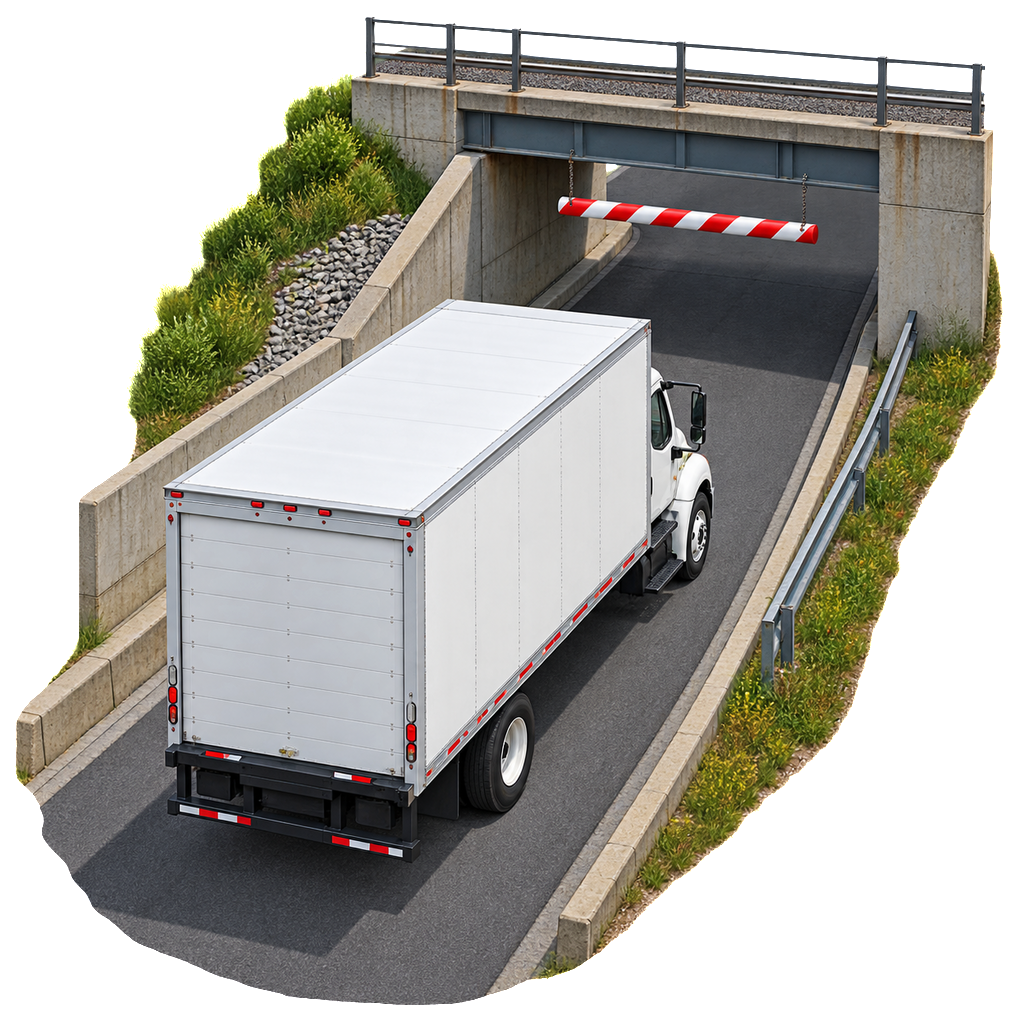
Road rules · CDLLow-Clearance Underpasses
A commercial driver is required to know the vehicle's exact height, loaded and empty, and to believe posted clearances over habit and navigation apps. A posted low clearance is a hard limit: if the number is not comfortably above your height, you do not enter.
On the testWhere this scenario is tested
This situation appears in 8 questions across 8 of our state banks, on CDL practice tests. Start with your state:
Try itA real practice question about this rule
Sample 1 · Speed Space And Road ConditionsAn empty box truck approaches a low structure whose posted clearance is close to the truck's measured height. Which factor deserves special attention?
- ATire pressure has no relationship to vehicle height
- BThe empty suspension may make the vehicle ride higher than when loadedCorrect
- CThe empty cargo area automatically lowers the roof
- DPosted clearance can be ignored when traffic is light
Why: A commercial driver's clearance check must consider posted heights, pavement changes, cargo height, and the possibility that an empty vehicle may ride higher than a loaded one. Therefore, the proposed supported response is "The empty suspension may make the vehicle ride higher than when loaded".
Every practice test explains its answers this way. Pick your state and take one free; no sign-up.
Choose your stateQuestionsQuestions about low-clearance underpasses
?What must a CDL driver know before any route?
The vehicle's actual height, loaded as it stands today. Every clearance decision compares the posted number against that height, with margin.
?What should I do at a low-clearance sign that is close to my height?
Stop before the structure and reroute. Creeping under to test it is how bridge strikes happen; the sign is the decision, not the start of an experiment.
?Why is car GPS dangerous for trucks?
It routes by distance and time with no knowledge of your height or weight, so it happily sends a thirteen-foot trailer to an eleven-foot underpass. Commercial routing exists for this reason.
?Can a posted clearance be wrong?
It can be tighter than posted after repaving or under packed snow, which is why manuals teach margin rather than exact-match arithmetic.
?How do low-clearance questions appear on the CDL test?
As judgment scenarios: what to do when the posted clearance is at or near vehicle height. The tested answer is stop and reroute, never proceed slowly.