Right Lane Closed Sign: Meaning and What to Do
The orange diamond reading RIGHT LANE CLOSED with a distance tells you a work zone is taking your rightmost lane out of service ahead. The distance is your merging budget: the road is telling you exactly how much room you have to be in a surviving lane.
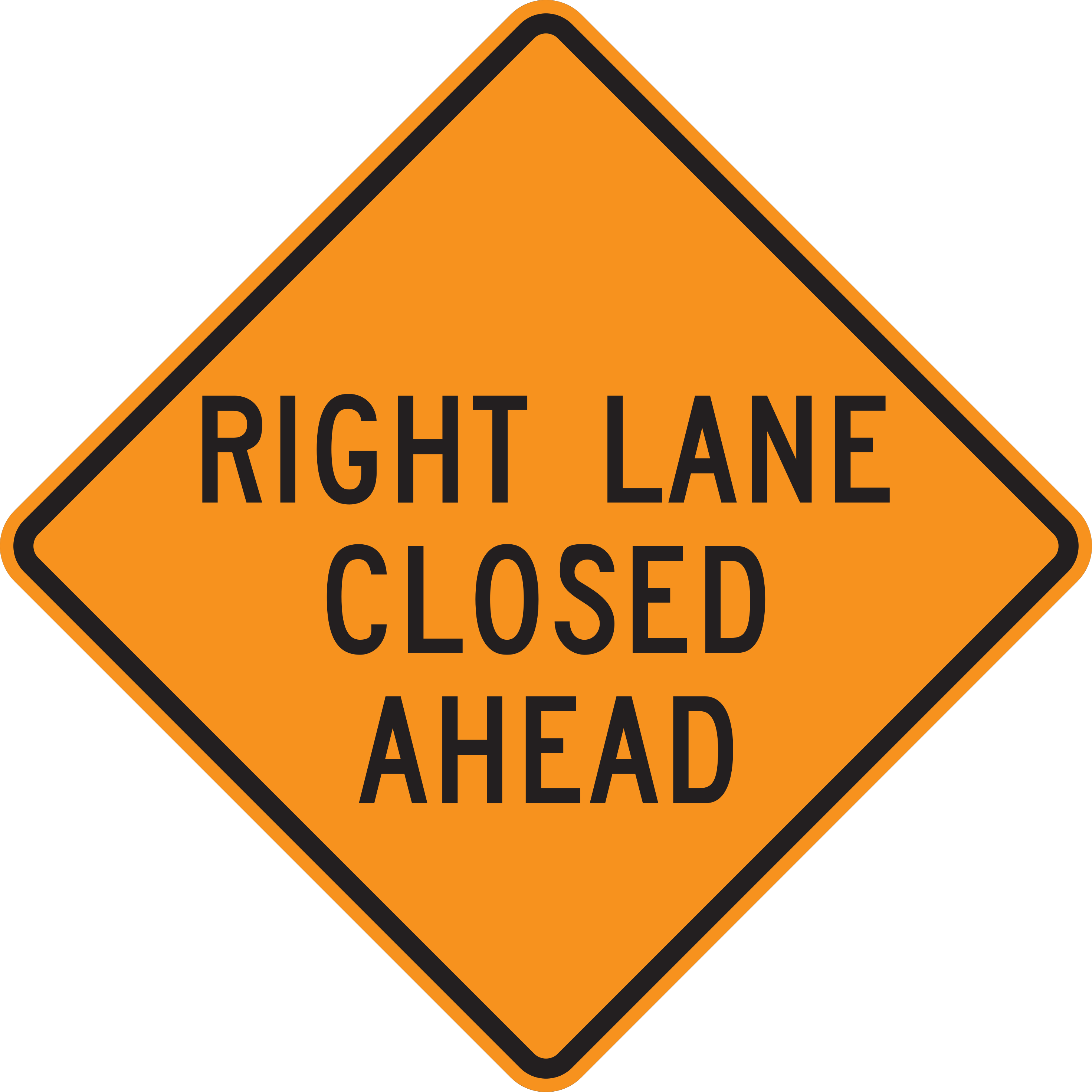
Right Lane Closed Sign
Lane closures are where work zones generate their crashes, in the merge, not the work area. The sign's early warning exists so the merge can happen at speed, smoothly, before the taper of cones forces it.
What to do when you see the right lane closed sign
If you are in the right lane, signal and merge left early, matching the speed of the receiving lane. If you are in the surviving lane, leave gaps that let the merge happen. In heavy congestion, alternating at the taper, one from each lane, keeps both lanes useful; in free flow, merge early and cleanly.
The signs it is confused with
Tests contrast it with the yellow Lane Ends warning, the permanent version of the same geometry, and with Road Work Ahead, which opens the zone generally. Orange always means the condition is temporary and workers may be present.
Signs are one topic of ten on every test
Every state practice test covers signs, signals, and markings among its ten topics, with every answer explained. Pick your state and see how its exam asks about signs like this one; it is free, with no sign-up.
Choose your stateQuestions about the right lane closed sign
What does the right lane closed sign mean?
A work zone closes the right lane at the stated distance ahead. Merge left before the taper, or hold gaps for merging traffic if you are already left.
When should I merge, early or at the closure?
In free-flowing traffic, early and predictably. In stop-and-go congestion, both lanes to the taper with polite alternation moves more cars; several state manuals now teach exactly that.
Why is the merge the dangerous part of a lane closure?
Speed differences: one lane braking for the taper while the other carries speed. The early warning distance exists to erase that difference before the cones.
How is this different from a yellow lane ends sign?
Yellow marks a permanent lane drop built into the road; orange marks a temporary closure with a work zone behind it, workers included, often with reduced limits and higher fines.
How do lane closure questions appear on the test?
As orange-family identification and merge-behavior scenarios, with the tested answer favoring early signals, matched speed, and courtesy at the taper.