T Intersection Sign: Meaning and What to Do
The yellow diamond with a T tells you your road ends ahead at a crossing road: you must turn left or right, because straight ahead there is no road. It is posted where the ending is hard to see in time, at night, over a crest, or on a fast rural stretch.
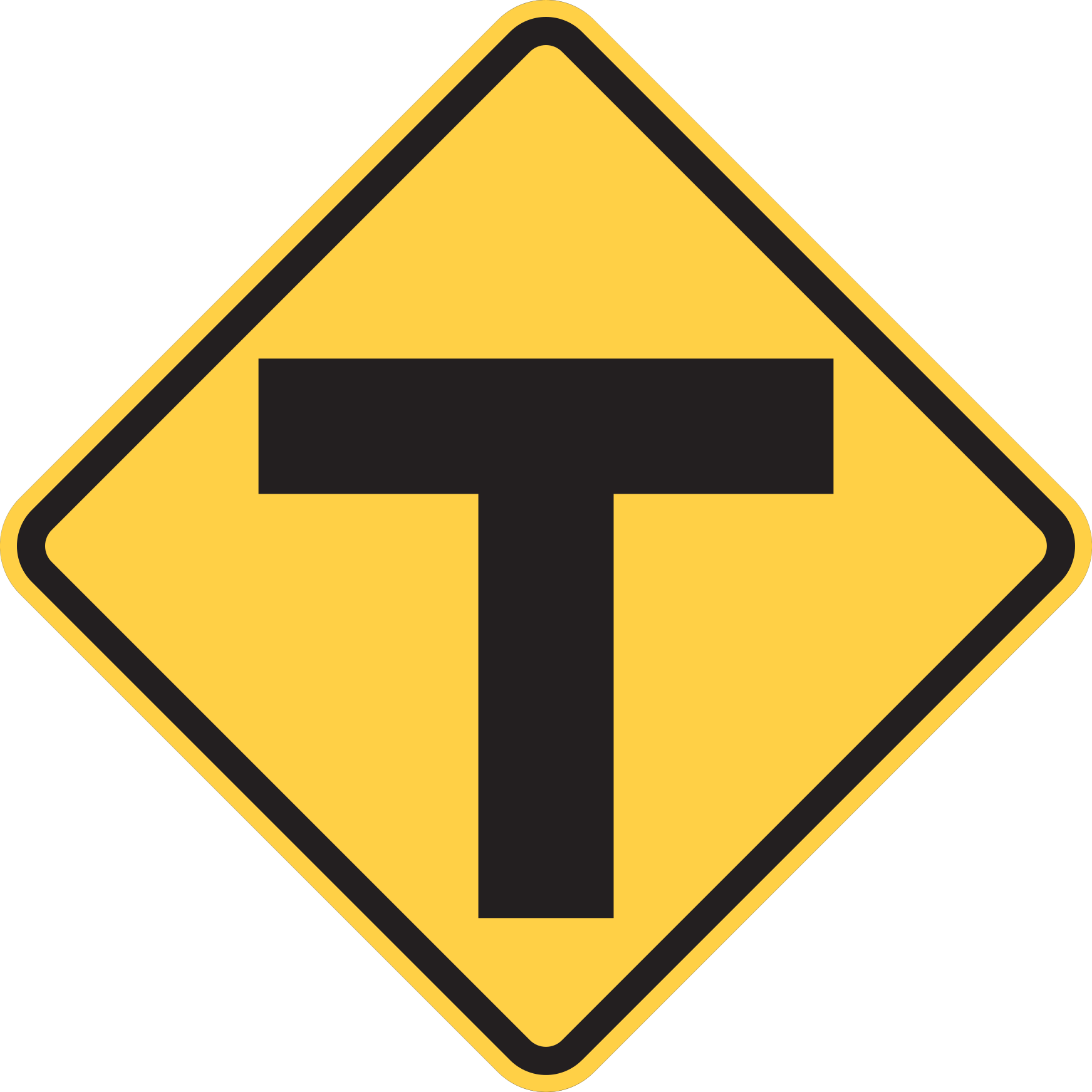
T Intersection Sign
Run-off-road crashes at T-ends are a known killer of drowsy and speeding drivers; the sign, often with a yield or stop at the junction and arrows across the far side, is the sequence that prevents them.
What to do when you see the t intersection sign
Slow early, decide your direction before the junction, and obey the control posted there; with none, yield to traffic on the through road. At night, treat the reflective arrows on the far side as the wall they are marking.
The signs it is confused with
Grouped with the other junction maps, and distinct from Dead End, which marks a road going nowhere; the T promises a through road to turn onto. The far-side large arrow sign often completes the warning.
Signs are one topic of ten on every test
Every state practice test covers signs, signals, and markings among its ten topics, with every answer explained. Pick your state and see how its exam asks about signs like this one; it is free, with no sign-up.
Choose your stateQuestions about the t intersection sign
What does the T intersection sign mean?
Your road ends at a crossing road ahead; you must turn left or right. Slow early and choose before you arrive.
Who yields at the T?
You do, to traffic on the through road, unless controls say otherwise. The road that ends gives way to the road that continues.
Why is the T sign a night-driving matter?
Headlights reveal the ending late, and a fast or drowsy driver can run straight through. The diamond plus far-side arrows exist for exactly that.
How does it differ from a dead end sign?
The T ends at a through road you turn onto; a dead end goes nowhere. One is a junction warning, the other a routing notice.
How is it tested?
Junction-map identification and right-of-way at the terminating road, phrased from each state's manual.