Road rules · Every driverBroken and Solid Yellow Lines
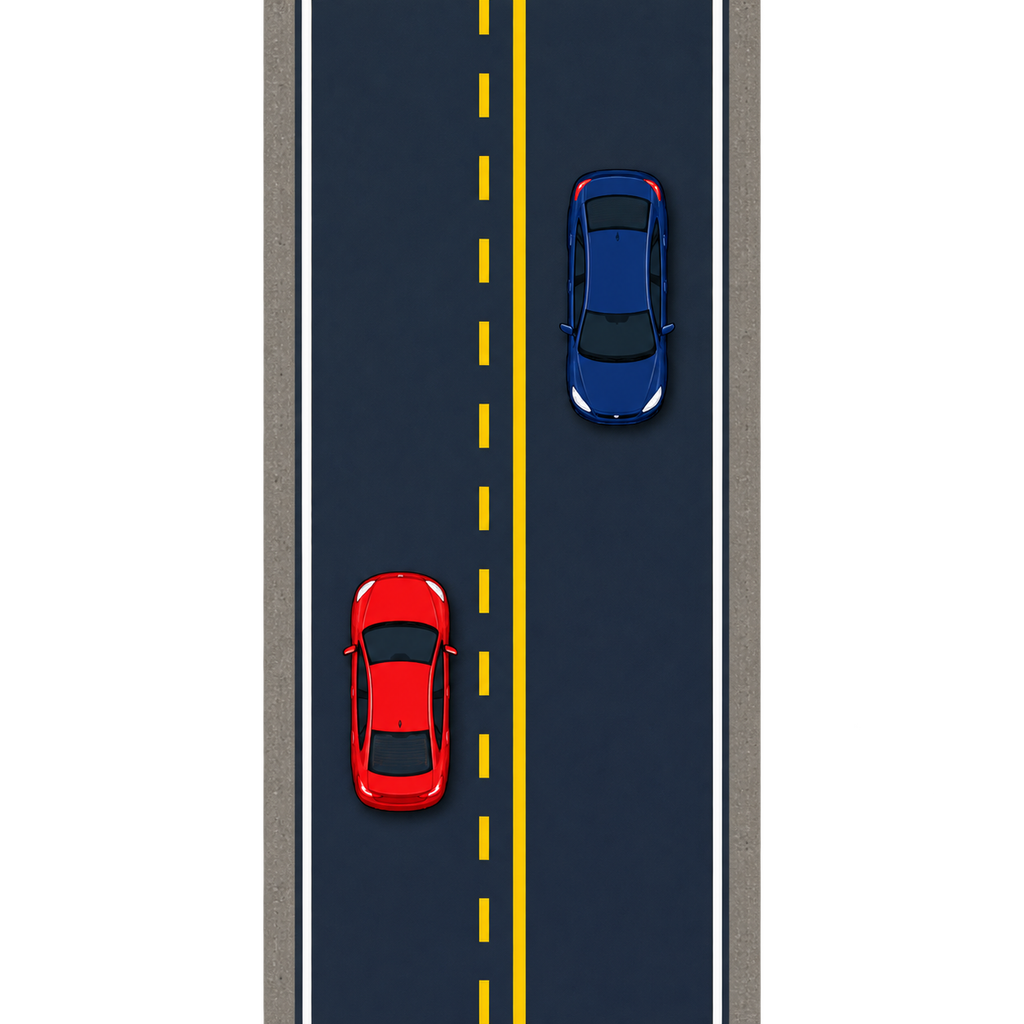
Yellow lines separate traffic moving in opposite directions, and their pattern is the passing rulebook. A broken yellow line beside your lane means you may cross it to pass when the way is clear. A solid yellow line beside your lane means passing is prohibited from your side.
On the testWhere this scenario is tested
This situation appears in 4 questions across 4 of our state banks, on Driver License practice tests. Start with your state:
Try itA real practice question about this rule
Sample 1 · Signs Signals Work Zones And Pavement MarkingsOpposing lanes are separated by one solid and one dashed yellow line. The solid line is on the driver's side. What does that marking mean for passing?
- APass after sounding the horn twice
- BDo not pass across the centerline from that sideCorrect
- CPass whenever the vehicle ahead is below the speed limit
- DPass only on the shoulder
Why: Where one solid and one dashed yellow line divide opposing traffic, a driver may pass only when the dashed line is on that driver's side and the maneuver is safe. Therefore, the supported response is "Do not pass across the centerline from that side".
Every practice test explains its answers this way. Pick your state and take one free; no sign-up.
Choose your stateQuestionsQuestions about broken and solid yellow lines
?What does a broken yellow line mean?
You may cross it to pass when the oncoming lane is clear and the pass can be completed safely. Broken means permitted, not recommended.
?What does a solid yellow line on my side mean?
No passing from your side. The line is solid where sight distance is too short to complete a pass safely, such as before curves and hill crests.
?Who may pass when one line is broken and one is solid?
Only the driver whose side has the broken line. Each direction reads the line nearest its own lane, which is the exact detail written tests check.
?What do yellow lines separate compared to white lines?
Yellow separates opposing traffic; white separates lanes moving the same direction. Knowing the color rule answers a whole family of marking questions.
?Is passing always safe where the line is broken?
No. The marking makes a pass legal; conditions make it safe. You still need a clear oncoming lane, enough zone left to finish, and speed in hand to return without crowding anyone.
More rules for every driver