Road rules · Every driverThe Center Left-Turn Lane
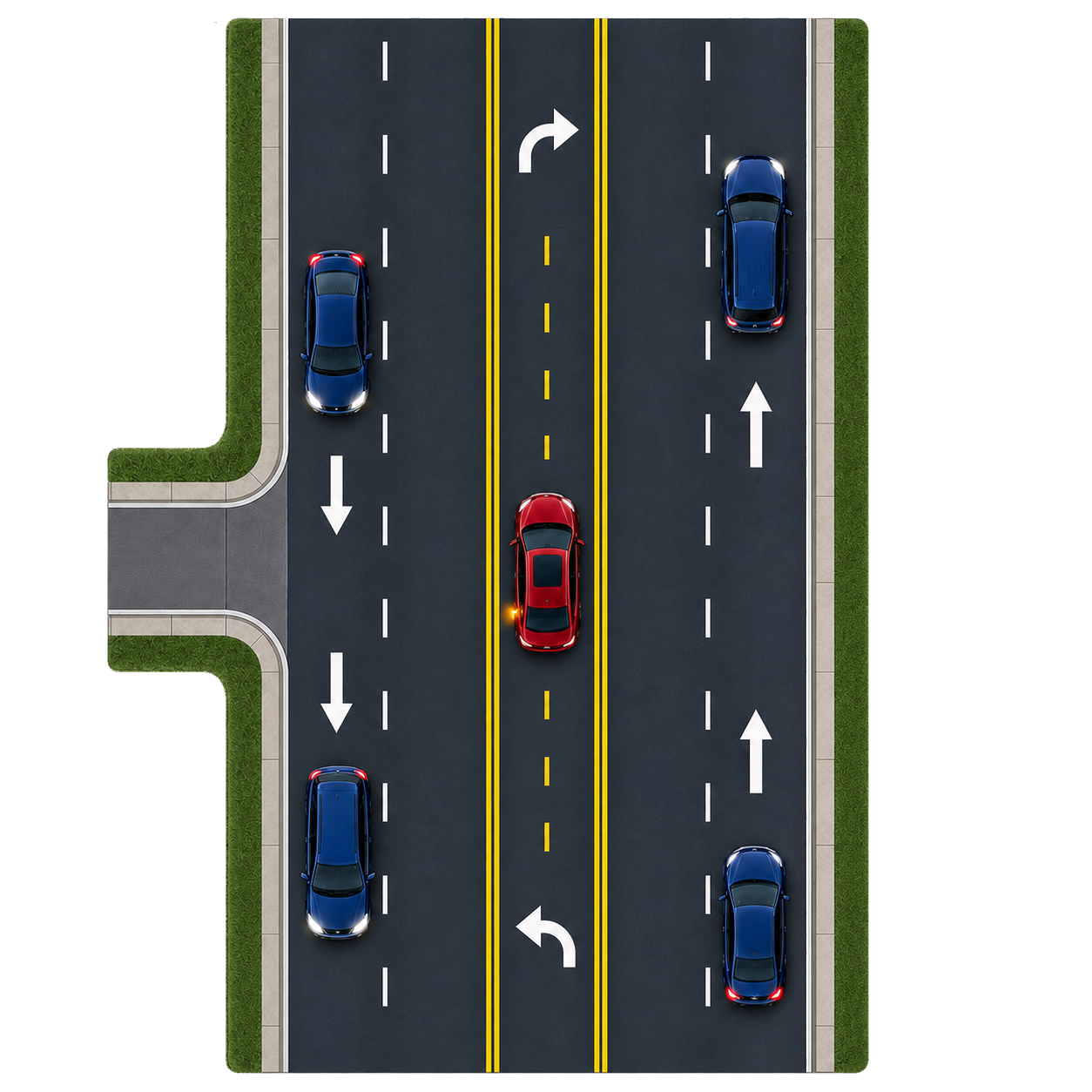
The lane in the middle of the road bounded by a solid yellow line outside and a broken yellow line inside is the two-way left-turn lane. Drivers from both directions use it for the last stretch before a left turn into a driveway or side street, and for finishing a left turn onto the road.
On the testWhere this scenario is tested
This situation appears in 4 questions across 4 of our state banks, on Driver License practice tests. Start with your state:
Try itA real practice question about this rule
Sample 1 · Lanes Turns And PassingHow may a center left-turn lane be used?
- AAs a regular passing lane
- BFor unlimited travel during congestion
- CAs a parking lane
- DFor up to 200 feet to prepare for a left turn or U-turnCorrect
Why: A center left-turn lane is for preparing for a left turn or U-turn, not for regular travel or passing, and a driver may travel in it for no more than 200 feet. Therefore, the supported response is "For up to 200 feet to prepare for a left turn or U-turn".
Every practice test explains its answers this way. Pick your state and take one free; no sign-up.
Choose your stateQuestionsQuestions about the center left-turn lane
?What is the center lane with yellow lines on both sides for?
Left turns only, from both directions: you enter it shortly before turning left into a driveway or side street, and drivers turning onto the road may use it to finish their turn.
?How do I recognize a two-way left-turn lane?
Solid yellow line on the outside of the lane, broken yellow line on the inside, usually with curved arrows painted in the lane facing both directions.
?Can I drive along the center turn lane to pass traffic?
No. It is not a travel or passing lane in any state. It exists to stage a turn, and using it to move past queued traffic is a violation.
?When should I enter the center turn lane before my turn?
Shortly before the turn, far enough to slow down out of through traffic but not so early that you travel along the lane. States phrase the distance differently; the principle is enter late, wait briefly, turn.
?Who else might be in the lane when I enter it?
A driver from the opposite direction staging their own left turn. Watch for them before you enter, since you share the same strip of pavement from opposite ends.
More rules for every driver