Road rules · Every driverFour-Way Stop Right of Way
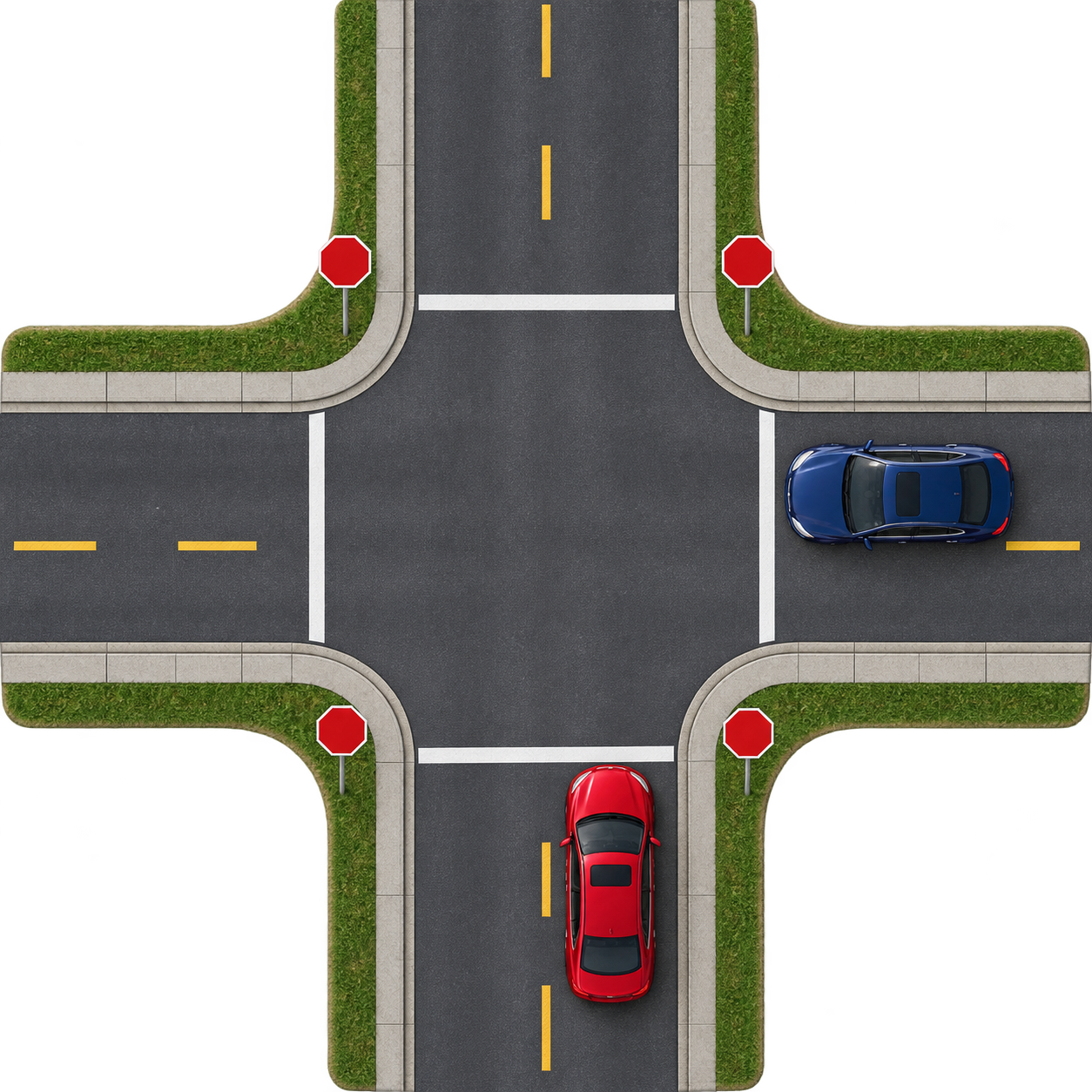
At an all-way stop, order of arrival is the law: the first vehicle to come to a complete stop is the first to go. The tie-breaker is geometric: when two vehicles stop at the same time, the driver on the left yields to the driver on the right.
On the testWhere this scenario is tested
This situation appears in 2 questions across 2 of our state banks, on Driver License practice tests. Start with your state:
Try itA real practice question about this rule
Sample 1 · Intersections Turns Right Of Way And CrosswalksAt a four-way stop, one driver clearly arrives before the others and stops completely. Who normally proceeds first?
- AThe driver farthest to the left
- BThe driver with the brightest headlights
- CThe last driver to arrive
- DThe first driver to reach and stop at the intersectionCorrect
Why: At a four-way stop, the driver who reaches the intersection first may go first after coming to a complete stop. Therefore, the supported response is "The first driver to reach and stop at the intersection".
Every practice test explains its answers this way. Pick your state and take one free; no sign-up.
Choose your stateQuestionsQuestions about four-way stop right of way
?Who goes first at a four-way stop?
The vehicle that stopped first. Arrival order is the primary rule, which is why a complete stop matters: it timestamps your place in line.
?What if two vehicles stop at the same time?
The driver on the left yields to the driver on the right. In the illustrated scenario, the car to your right goes first and you follow.
?What if all four directions stop at once?
The yield-to-the-right rule works around the intersection, usually starting with an exchange of eye contact and one driver committing. Move predictably and take your turn in order.
?Does turning change the order at an all-way stop?
Arrival still governs, but a left-turning driver facing a simultaneous opposite arrival yields to the through vehicle, the same as at any intersection.
?Why do manuals say right of way is given, not taken?
Because the rules only order the intersection when everyone applies them defensively. Insisting on a turn someone else is taking causes the crash the rules exist to prevent.
More rules for every driver