Road rules · Motorcycle LicenseThe Following-Distance Count
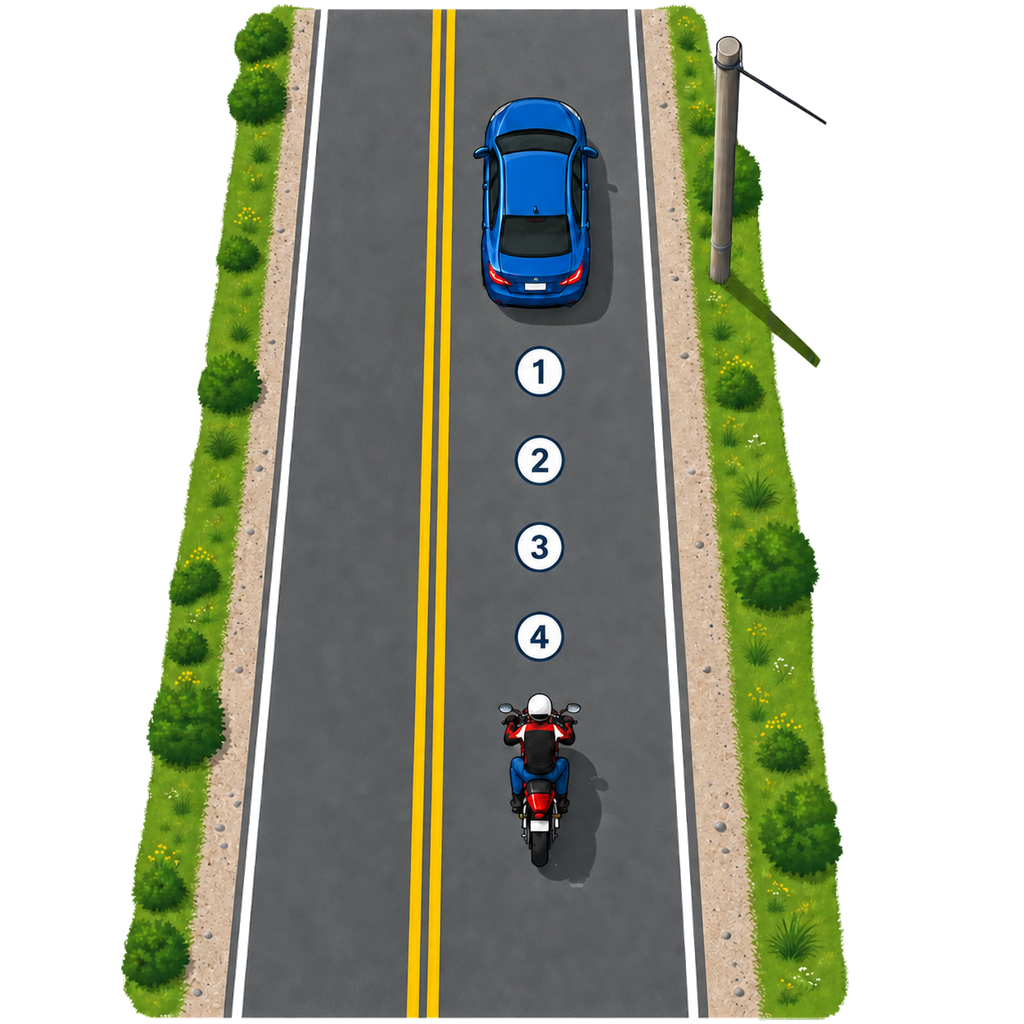
Following distance is measured in time, not car lengths: pick a fixed point the vehicle ahead passes, and count the seconds until you reach it. Riders keep more of it than drivers because a motorcycle's crash margin is thinner: manuals teach a minimum of several seconds, with many states now teaching four in good conditions.
On the testWhere this scenario is tested
This situation appears in 6 questions across 6 of our state banks, on Motorcycle License practice tests. Start with your state:
Try itA real practice question about this rule
Sample 1 · Lane Position Following Passing And MergingA new Georgia rider reaches a roadside marker only three seconds after the car ahead. What adjustment is supported by the manual?
- AIgnore time because motorcycles stop instantly
- BIncrease the gap until it is at least four secondsCorrect
- CMove closer until the gap is one second
- DPass on the shoulder immediately
Why: The manual recommends that new motorcycle operators maintain at least a four-second following interval under ordinary conditions. Therefore, the supported response is "Increase the gap until it is at least four seconds".
Every practice test explains its answers this way. Pick your state and take one free; no sign-up.
Choose your stateQuestionsQuestions about the following-distance count
?How is following distance measured on a motorcycle?
In seconds: watch the vehicle ahead pass a fixed point and count until you reach the same point. The count works at any speed, which car-length rules never did.
?How many seconds should a rider keep?
More than a car driver. State motorcycle manuals teach a minimum of several seconds in good conditions, four in many states, and more in rain, at night, or on poor surfaces.
?Why do riders need more following distance than drivers?
The rider needs to see the road surface beyond the vehicle ahead, and has less margin for error in a sudden stop. Time headway buys both.
?When should the following distance grow beyond the minimum?
Rain and slick surfaces, night riding, gravel, heavy traffic, carrying a passenger or load, and behind vehicles that block your view ahead. Every one of them appears in test questions.
?Does the count replace checking mirrors?
No. Space ahead is half the cushion; manuals pair it with mirror checks and an escape path to the side, so a tailgater behind you has an answer too.