Road rules · Motorcycle LicenseThe Left-Turning Car
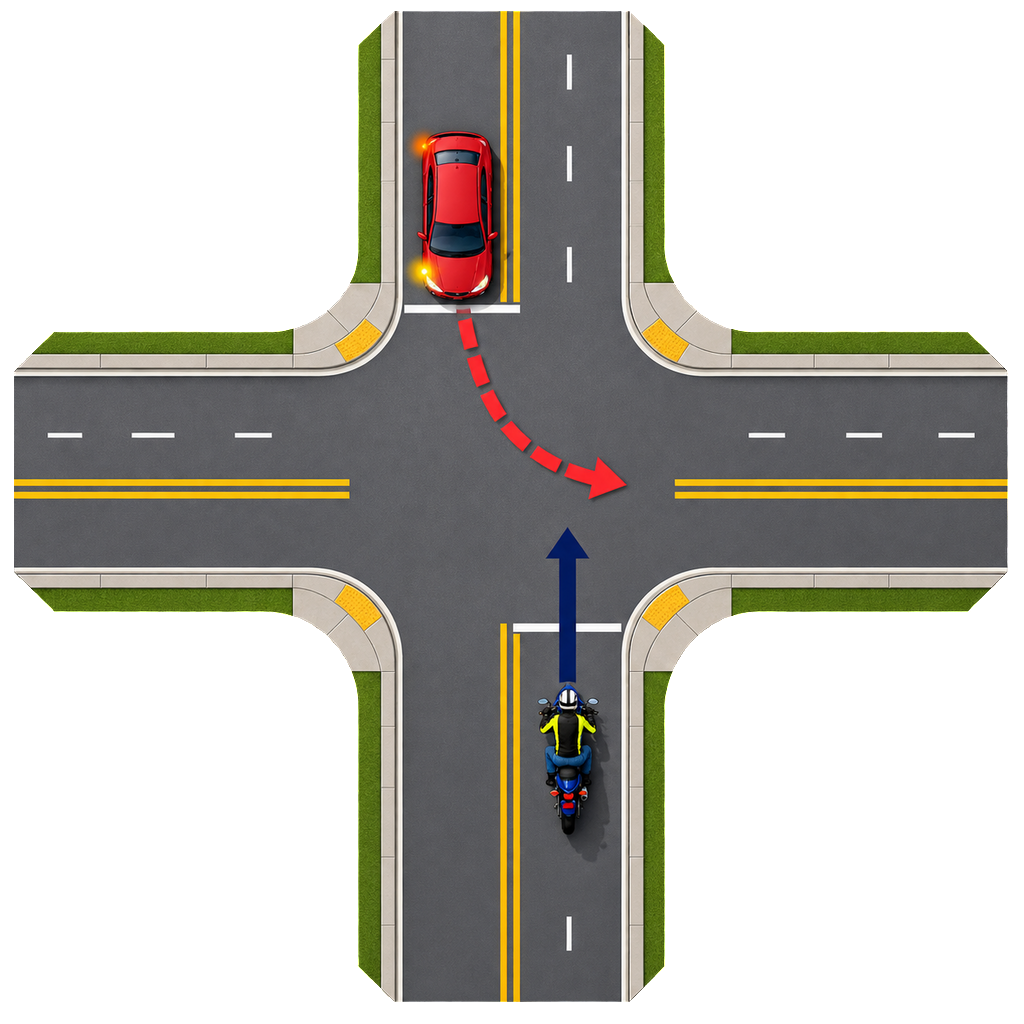
The single most common car-motorcycle collision is an oncoming car turning left across a rider going straight. The driver looks, sees nothing they register as a threat, and turns; the motorcycle's narrow profile makes its distance and speed genuinely hard to judge.
On the testWhere this scenario is tested
This situation appears in 14 questions across 14 of our state banks, on Motorcycle License practice tests. Start with your state:
Try itA real practice question about this rule
Sample 1 · See Intersections Conspicuity Signals And HornsWhich intersection movement deserves special attention from a motorcyclist approaching on a through road?
- AA train visible on an unrelated parallel track
- BAn oncoming vehicle positioned to turn left across the motorcycle's pathCorrect
- CA vehicle parked in a closed garage
- DA car traveling away on a separate divided road
Why: At intersections, vehicles turning left across the rider's path and vehicles entering from side streets are major conflict sources, so the rider should use SEE and preserve time and space. Therefore, the supported response is "An oncoming vehicle positioned to turn left across the motorcycle's path".
Every practice test explains its answers this way. Pick your state and take one free; no sign-up.
Choose your stateQuestionsQuestions about the left-turning car
?What is the most common car-motorcycle crash?
An oncoming car turning left across a motorcycle going straight at an intersection. Every state motorcycle manual names it, and the written tests return to it constantly.
?Why do drivers turn across motorcycles they looked straight at?
A motorcycle's narrow single-headlight profile defeats distance and speed judgment. The driver honestly sees a gap that is not there.
?What should a rider do approaching an oncoming left-turner?
Slow down, cover the brake, move to the lane position that makes you most visible, and plan an escape path. Assume the turn happens, and be pleased when it does not.
?Does eye contact with the driver mean I am safe?
No. Drivers look at riders and still pull out. Watch the car's front wheels for the first sign of movement; wheels do not miscommunicate.
?Does having the right of way protect me here?
Legally yes, physically no. The manuals' point is that the rider's job is to survive the intersection, and the slow-cover-position habit is how.