Road rules · Motorcycle LicenseCrossing Angled Railroad Tracks on a Motorcycle
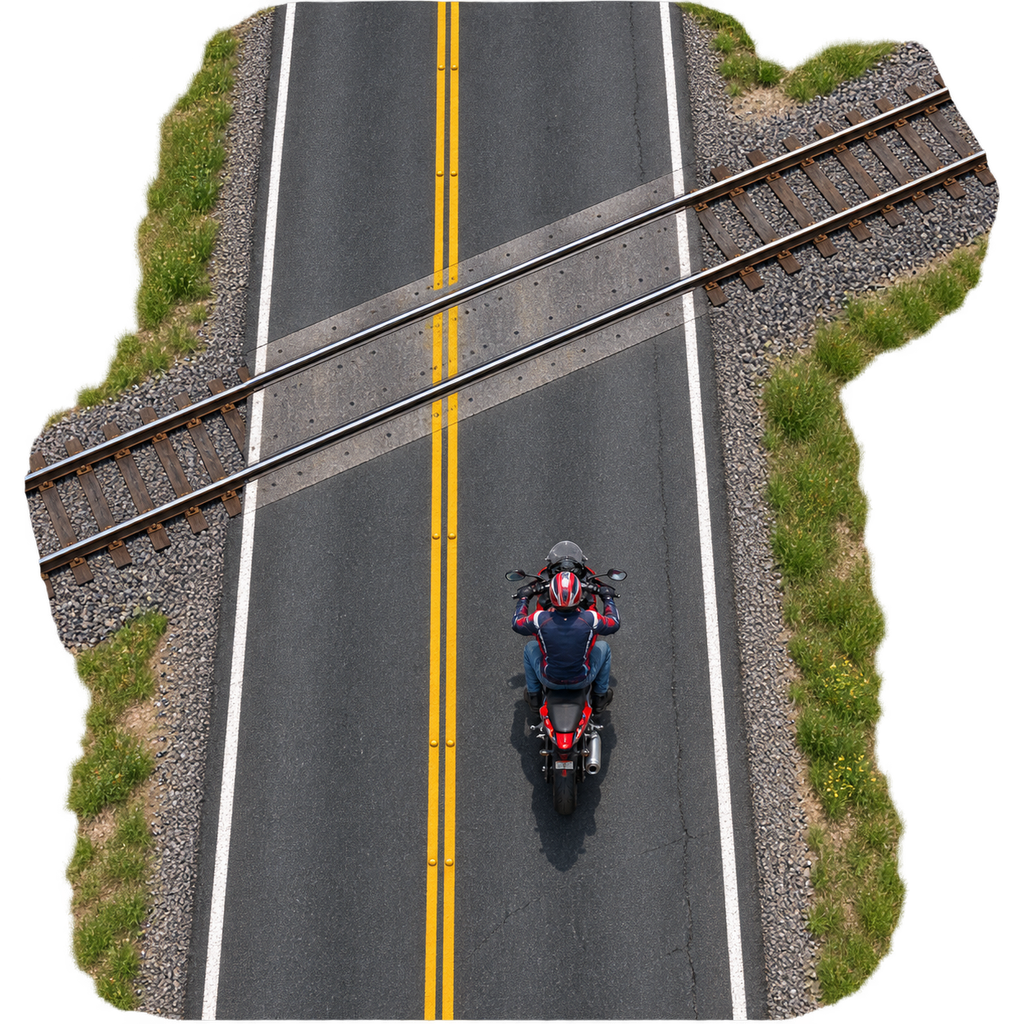
Rails are steel, often wet, always slick, and when they cross the road at an angle they can grab a motorcycle's front wheel and steer it along the track. The rule for ordinary angled crossings: stay in your lane, keep the motorcycle upright and straight, and ride across at your normal path; a safe crossing angle does not require swerving into another lane.
On the testWhere this scenario is tested
This situation appears in 19 questions across 19 of our state banks, on Motorcycle License practice tests. Start with your state:
Try itA real practice question about this rule
Sample 1 · Crash Avoidance Night Riding And Dangerous SurfacesIn the illustrated diagonal railroad-track approach, which path avoids an unnecessary lane departure?
- AContinue straight within the lane across the tracks instead of turning toward a forced right-angle crossingCorrect
- BTurn sharply across the centerline so both tires meet the rails at exactly 90 degrees
- CFollow one rail lengthwise until an intersection appears
- DStop on the first rail and pivot the motorcycle across the second
Why: For tracks crossing the rider's path, the manual says riding straight within the lane is usually safer than turning to seek a 90-degree crossing that could carry the motorcycle into another traffic lane. Therefore, the supported response is "Continue straight within the lane across the tracks instead of turning toward a forced right-angle crossing".
Every practice test explains its answers this way. Pick your state and take one free; no sign-up.
Choose your stateQuestionsQuestions about crossing angled railroad tracks on a motorcycle
?How should a motorcycle cross angled railroad tracks?
Within your lane, upright and steady, adjusting your path only enough to meet the rails at a safe angle, generally at least around forty-five degrees. No braking or leaning on the rails themselves.
?Why are rails dangerous for motorcycles?
Steel is slick, especially wet, and an angled rail can channel the front tire along it. The wheel must cross over the rail decisively rather than touch it lengthwise.
?Should I swerve to cross tracks at exactly ninety degrees?
No. Manuals warn against swerving out of your path for a perfect angle; a safe angle within your lane is the instruction, because the swerve creates a traffic hazard worse than the rails.
?What about rain at rail crossings?
Wet steel is among the slickest surfaces a rider meets. Slow earlier, cross more upright, and keep every input, throttle, brake, steering, off the rails themselves.
?How do track-crossing questions appear on the motorcycle test?
As angle-and-technique questions, often with a diagram of diagonal tracks. Our motorcycle banks illustrate it the same way the state manuals do.