Road rules · Motorcycle LicenseLoose Gravel on a Motorcycle
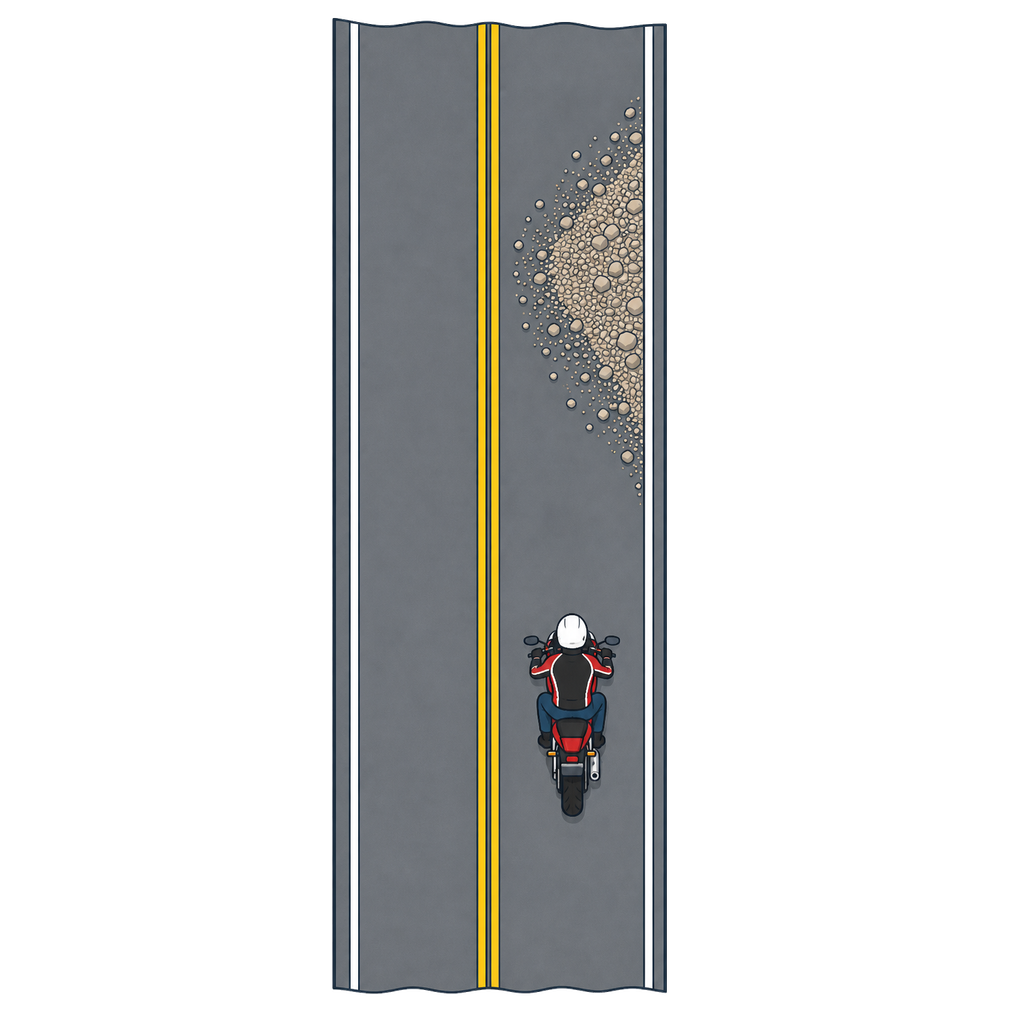
Gravel is ball bearings between tire and pavement: it cuts the grip available for everything, and it punishes exactly the inputs a startled rider makes. The rule is to do the slowing before the patch, then cross it upright, steady, and gentle, no braking, no acceleration, no lean you can avoid.
On the testWhere this scenario is tested
This situation appears in 11 questions across 11 of our state banks, on Motorcycle License practice tests. Start with your state:
Try itA real practice question about this rule
Sample 1 · Hazardous Surfaces Wind Animals Tracks And Mechanical ProblemsA rider reaches an unavoidable stretch of loose gravel. Which control plan best preserves traction?
- AAccelerate hard and increase lean angle
- BLock the rear wheel to create a straight groove
- CStay upright and use smooth throttle, steering, and gentle brake inputsCorrect
- DMake a sudden direction change while grabbing the front brake
Why: On a slippery surface, the rider should slow before reaching it, keep the motorcycle upright, avoid abrupt changes, and apply both brakes gently, including gradual front-brake pressure. Therefore, the supported response is "Stay upright and use smooth throttle, steering, and gentle brake inputs".
Every practice test explains its answers this way. Pick your state and take one free; no sign-up.
Choose your stateQuestionsQuestions about loose gravel on a motorcycle
?How should a motorcycle cross loose gravel?
Slow down before it, then cross upright and steady with no braking, no sharp throttle, and as little lean as the road allows. All the riding happens before the patch.
?Why is gravel so dangerous for motorcycles?
It rolls between tire and road, cutting grip unpredictably. Two small contact patches have no spare traction to lose, so sudden inputs slide the tire.
?Where does gravel usually collect?
Curve edges, driveway and side-road mouths, the pavement edge, and work zones. Manuals teach scanning for it because it is visible ahead to a rider looking far enough.
?What if I find gravel in the middle of a curve?
Straighten the bike as much as the lane allows, cross the patch upright, then finish the curve. Lean angle is the thing gravel punishes most.
?How do gravel questions appear on the motorcycle test?
As surface-hazard questions: the technique for crossing, where it collects, and its effect in curves. Our banks illustrate them the way the manuals do.