Road rules · Every driverResidential Streets and Hidden Children
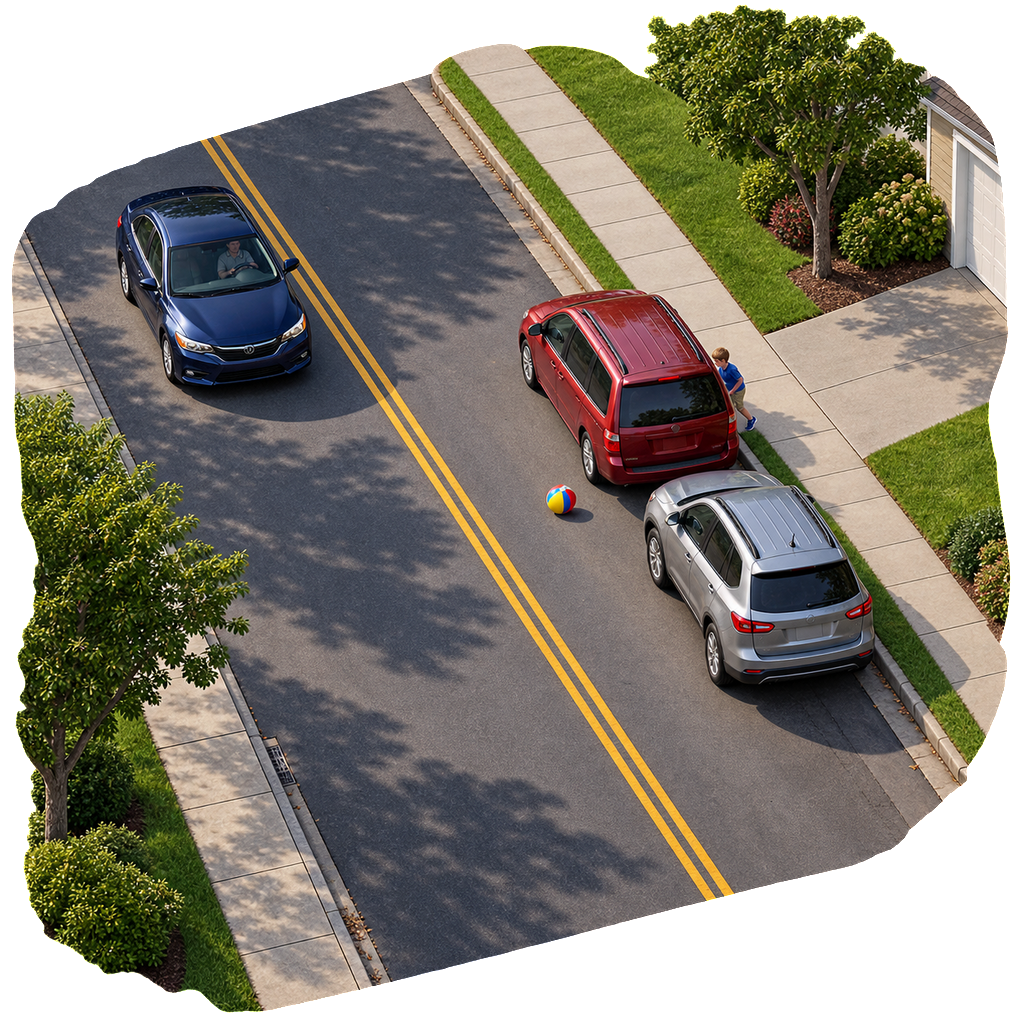
On a residential street, the rule of thumb every manual teaches: a ball rolling into the road is a child following it. Parked cars turn the curb into a screen, and what emerges from between them is small, quick, and certain you have seen them.
On the testWhere this scenario is tested
This situation appears in 2 questions across 2 of our state banks, on Driver License practice tests. Start with your state:
Try itA real practice question about this rule
Sample 1 · Pedestrians Schools Bicycles And MotorcyclesThe illustrated ball rolls into the lane from between parked vehicles while a child is partly hidden on the sidewalk. What should the driver do?
- AMove closer to the parked vehicles to avoid the center line
- BAccelerate before the child can enter the road
- CSlow down, leave extra space from the parked vehicles, and prepare to stopCorrect
- DMaintain speed because the child has not entered the lane
Why: In residential areas and places where children are likely, drivers should be extra careful, avoid driving too close to parked cars that block their view, and be ready for unpredictable children. Therefore, the supported response is "Slow down, leave extra space from the parked vehicles, and prepare to stop".
Every practice test explains its answers this way. Pick your state and take one free; no sign-up.
Choose your stateQuestionsQuestions about residential streets and hidden children
?What does a ball rolling into the street mean?
A child is likely following it. The manuals' phrasing varies; the tested response never does: slow or stop immediately and be ready for someone to run out between the parked cars.
?Why are parked cars the core hazard on residential streets?
They hide anything shorter than their rooflines, which includes every child. The gaps between them are where pedestrians appear with no warning distance.
?How should I scan a residential street?
Low speed, eyes moving between the road, the gaps between parked cars, and the space under them, where feet and pets show before bodies do, with the brake covered near any sign of play.
?What speed is right when children are near the road?
At or below the limit, slow enough to stop within the distance you can actually see. Some states post lower residential and school-area limits; the seeing-distance principle is universal.
?How do these questions appear on the permit test?
As the ball-and-child scenario, sometimes word for word. It is one of the oldest questions in driver education because the crash it prevents is one of the worst.
More rules for every driver