Road rules · Every driverNever Stop on the Tracks
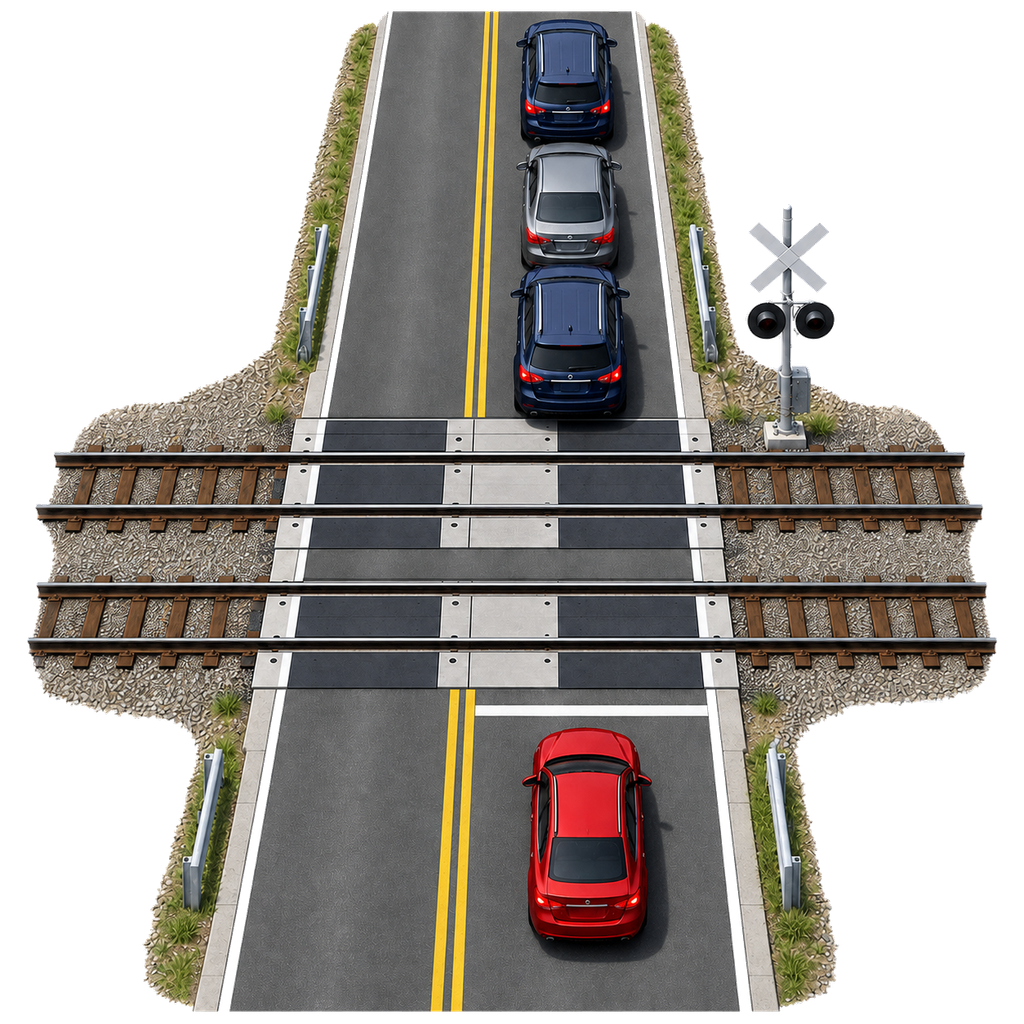
The illustrated trap is ordinary traffic: a queue on the far side of a railroad crossing, and a driver deciding whether to follow the car ahead across. The rule is absolute: never enter a crossing unless there is room for your entire vehicle on the other side, with margin. If the exit is blocked, you wait before the tracks, however green everything looks.
On the testWhere this scenario is tested
This situation appears in 9 questions across 8 of our state banks, on Driver License and CDL practice tests. Start with your state:
Try itA real practice question about this rule
Sample 1 · Rail Light Rail Parking And StoppingTraffic beyond railroad tracks leaves no room for your entire car. What should you do?
- AWait before the tracks until space opensCorrect
- BEnter and stop across the rails
- CFollow the car ahead halfway
- DDrive around any lowered gate
Why: A driver may cross railroad tracks only when certain that the entire vehicle can clear the crossing, and must never stop on the tracks. Therefore, the supported response is "Wait before the tracks until space opens".
Every practice test explains its answers this way. Pick your state and take one free; no sign-up.
Choose your stateQuestionsQuestions about never stop on the tracks
?When may I drive onto a railroad crossing?
Only when there is room for your whole vehicle, with margin, on the far side. A queue beyond the crossing means you wait before the tracks.
?What should I do if my car stalls on the tracks?
Get everyone out immediately and walk toward the approaching train, angled away from the tracks, so debris from an impact flies past you. Then call the emergency number posted at the crossing.
?Why walk toward the train after evacuating?
A struck vehicle's debris travels in the train's direction of movement. Walking toward the train, angled away from the rails, keeps you out of that path.
?How long does a train need to stop?
A freight at highway speed can need a mile or more. By the time its crew can see your car on the crossing, the outcome is already physics.
?How do crossing questions appear on the written test?
As the far-side clearance rule and the stalled-vehicle evacuation. Both come from the same illustrated situation our banks use.
More rules for every driver